
Becoming a manager for the first time is exciting, validating, and honestly… a little terrifying.
One minute you’re doing your job, and the next, you’re responsible for leading a team, making decisions, solving problems, and somehow knowing what you’re doing 24/7.
If you’re a young woman stepping into leadership for the first time, you’ve probably asked yourself:
- Am I doing enough?
- Do my employees respect me?
- Am I being too nice… or too strict?
- What actually makes someone a good manager?
First of all: take a breath. Every great leader starts somewhere.
No one becomes an incredible manager overnight. Leadership is learned through experience, mistakes, self-awareness, and growth.
If you’re completely new to leadership, you may also love my post on What Every Young Woman Should Know Before Leading Her First Team, where I break down the mindset shifts that happen when you step into management for the first time.
If you’re reading this, chances are you genuinely care about becoming a better leader — and honestly, that already puts you ahead of a lot of people.
Here are the most common mistakes first-time managers make, and how you can avoid them while growing into a confident, respected leader.
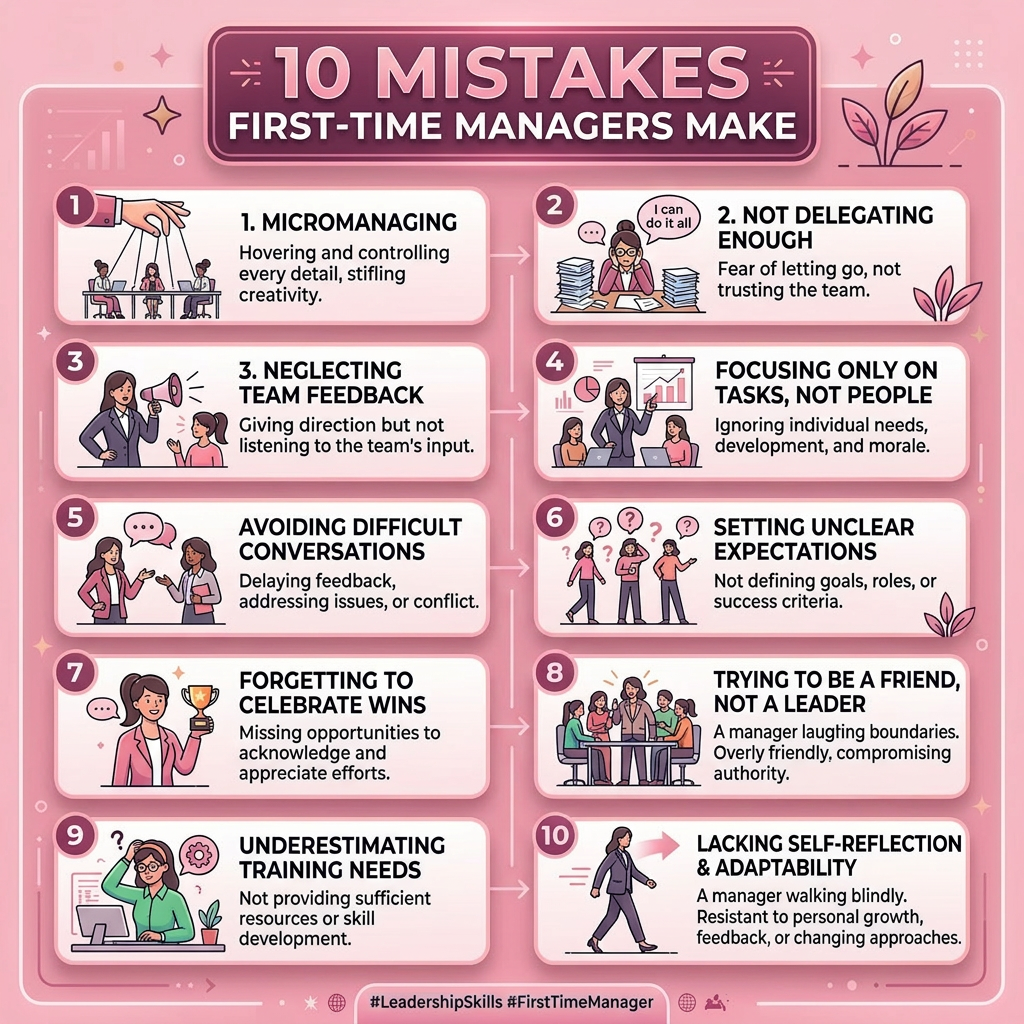
1. Micromanaging Your Team
One of the biggest mistakes new managers make is trying to control everything.
This usually comes from anxiety, not bad intentions. When you care about doing well, it’s easy to feel like you need to oversee every detail to make sure nothing goes wrong.
But here’s the truth: constantly hovering over employees creates frustration, tension, and distrust.
Your team does not want someone watching their every move or correcting every tiny thing. Most employees perform better when they feel trusted and empowered.
A strong manager guides the team — they don’t suffocate it.
What To Do Instead
Create systems for communication instead of checking in every five minutes.
Weekly one-on-one meetings, KPI reviews, and team check-ins are great ways to stay informed without micromanaging. Give employees room to problem-solve and complete tasks in their own way.
Remember: there is more than one way to get a great result.
2. Not Taking Time to Know Your Team
The opposite of micromanaging is being completely disconnected.
Employees want to feel seen, valued, and supported by leadership. If your team barely knows you — or feels like you don’t care about them beyond productivity — morale will suffer quickly.
Great leadership is built on relationships.
You don’t need to become everyone’s best friend, but you should understand:
- What motivates your employees
- Their communication styles
- Their strengths
- Their career goals
- What support they need to succeed
When people feel valued, they perform better.
What To Do Instead
Schedule regular check-ins and actually listen during conversations.
Ask employees about their goals and follow up later. Remember small details. Celebrate wins. Be approachable.
Team bonding outside the office can also help build stronger connections and improve communication.
3. Trying Too Hard to “Look” Like a Manager
Most first-time managers feel pressure to prove themselves.
Sometimes that turns into overcompensating:
- Acting overly authoritative
- Trying to impress upper management constantly
- Overexplaining accomplishments
- Taking on everything yourself
People can usually sense when leadership feels forced.
The most respected managers are confident in who they are. They don’t need to perform leadership — they naturally grow into it.
One of the biggest mindset shifts I discuss in my article on What Every Young Woman Should Know Before Leading Her First Team is learning that leadership is less about proving yourself and more about building trust and consistency.
What To Do Instead
Focus on bringing genuine value to your team and department.
Instead of worrying about appearing impressive, focus on:
- Solving problems
- Supporting your team
- Improving processes
- Communicating clearly
- Staying consistent
Confidence becomes much more natural when you stop trying to “prove” yourself all the time.
4. Oversharing With Employees
If you were promoted internally, this one can be especially difficult.
You may already have friendships with coworkers, and adjusting those boundaries after becoming a manager can feel uncomfortable.
But leadership requires professionalism.
Oversharing personal details, workplace gossip, or overly casual conversations can blur boundaries and damage credibility over time.
Employees should feel comfortable around you — but they should also respect you as a leader.
What To Do Instead
Be friendly without making employees your emotional support system.
Before sharing something personal, ask yourself:
- Is this appropriate for work?
- Would this make someone uncomfortable?
- Does this help or hurt my credibility?
A good manager creates a safe and professional environment for everyone.
5. Not Dressing Like a Leader
Fair or unfair, appearance affects perception in the workplace.
As a manager, people naturally look to you to set the tone and standard for professionalism.
That doesn’t mean you need expensive clothes or designer brands. You simply want to appear polished, intentional, and put together.
What To Do Instead
Plan outfits ahead of time and invest in versatile professional basics that make you feel confident.
If you’re building a work wardrobe on a budget, stores like Marshalls and TJ Maxx are amazing for affordable office outfits.
And honestly? Pinterest is one of the best places to find office outfit inspiration for young professional women.
6. Not Understanding Your Performance Metrics
One of the most overlooked leadership mistakes is not fully understanding how your own performance is being measured.
If you don’t know:
- Your department goals
- Your KPIs
- Leadership expectations
- Evaluation standards
…you’ll struggle to lead your team effectively.
You cannot guide a team toward success if you don’t know what success actually looks like.
What To Do Instead
Have a conversation with your direct supervisor and ask for clarity on:
- Department goals
- Expectations
- Performance measurements
- Short-term priorities
- Long-term objectives
Clear expectations create stronger leadership.
7. Staying Comfortable Instead of Improving Processes
A great manager doesn’t just maintain systems — she improves them.
If you notice inefficiencies, communication gaps, or outdated processes, don’t ignore them.
Strong leaders think strategically and continuously look for ways to improve the workplace.
What To Do Instead
Set aside dedicated time each week to focus on:
- Process improvement
- Team efficiency
- Training opportunities
- Workflow organization
- Long-term goals
Sometimes the best thing you can do as a leader is step back and think bigger.
8. Leading Through Fear Instead of Kindness
We’ve all had that manager:
- Constantly critical
- Passive aggressive
- Condescending
- Easily irritated
- Quick to embarrass employees publicly
And chances are… nobody respected them as much as they thought.
Fear might create short-term compliance, but it destroys trust long-term.
Kind leaders are not weak leaders.
The best managers know how to hold employees accountable while still treating people with empathy and respect.
What To Do Instead
Correct mistakes professionally without humiliating people.
Instead of saying:
“You should already know this.”
Try:
“Let’s walk through it together one more time.”
Employees are human beings first. The way you speak to people matters more than you realize.
9. Refusing to Delegate
A lot of first-time managers believe they need to do everything themselves to prove they deserve their role.
That mindset leads directly to burnout.
Delegation is not laziness — it’s leadership.
Your employees want opportunities to grow, learn new skills, and take ownership of responsibilities.
What To Do Instead
Start trusting your team with meaningful tasks and projects.
Delegating:
- Reduces your stress
- Builds employee confidence
- Improves team engagement
- Develops future leaders
A strong team should not depend on one person for everything.
10. Forgetting to Keep Employees Engaged
Employees who feel bored, disconnected, or stagnant eventually lose motivation.
One of the biggest responsibilities of leadership is creating an environment where people feel challenged, supported, and encouraged to grow.
People want to feel like their work matters.
What To Do Instead
Have ongoing conversations about:
- Career goals
- Skill development
- Workload balance
- Growth opportunities
Pay attention to who feels overwhelmed and who feels underutilized.
Engaged employees are happier, more productive, and more likely to stay long-term.
Final Thoughts
No first-time manager has everything figured out.
You are going to make mistakes. You are going to second-guess yourself. You are going to have difficult days where you wonder whether you’re actually good at leadership.
That’s normal.
The goal isn’t perfection — it’s growth.
The fact that you care enough to improve already says a lot about the kind of leader you’re becoming.
Leadership is not about being the loudest person in the room or acting like you know everything. It’s about creating an environment where people feel supported, respected, motivated, and guided.
And if you’re still adjusting to your first leadership role, I highly recommend reading my full guide on What Every Young Woman Should Know Before Leading Her First Team. It’s packed with advice for navigating confidence, communication, and leadership as a young woman stepping into management for the first time.
And trust me: those are the managers people never forget.

 The Renewal Mindset
Leave a reply to You’re a First-Time Manager: What Every Young Woman Should Know Before Leading Her First Team – The Renewal Mindset Cancel reply